Google Just Launched AI Trip Planning. Here's Why I'm Not Worried About Your Business
Google just rolled out Canvas, Flight Deals, and AI Mode to over 200 territories. The tool pulls flight data, hotel suggestions, photos, and reviews from Google Maps into what basically amounts to a personalized travel magazine.
I've watched the panic spread through travel advisor communities.
The fear is real. If planning happens inside Google, fewer people click out to the sites that have historically owned the early funnel. That includes you.
But here's what 25 years of watching tech disruption has taught me: the tools that automate tasks don't eliminate the people who understand humans.
They eliminate the people who were only doing tasks.
What Google's AI Actually Does Well
Let's be honest about what these tools can do.
Google's Canvas aggregates data fast. It pulls real-time flight prices, hotel availability, and reviews into one interface. It handles the research grunt work that used to take clients hours.
For simple trips, it works.
But here's what I know from living nomadically with my family for six years across multiple continents: AI tools miss what experienced travelers know instinctively.
They don't factor in airport arrival times properly. They suggest geographically incompatible activities. They don't allow time for rest. They don't account for how jetlag actually feels or how long it takes to really experience a place.
AI lacks curiosity. It doesn't understand the thrill of exploring or moments of unexpected joy. Those aren't part of a virtual assistant's equation.
The Numbers Tell a Different Story Than the Fear
Here's what's actually happening in the data:
Only 2% of travelers are willing to give AI full autonomy to make and modify bookings without human oversight.
Think about that.
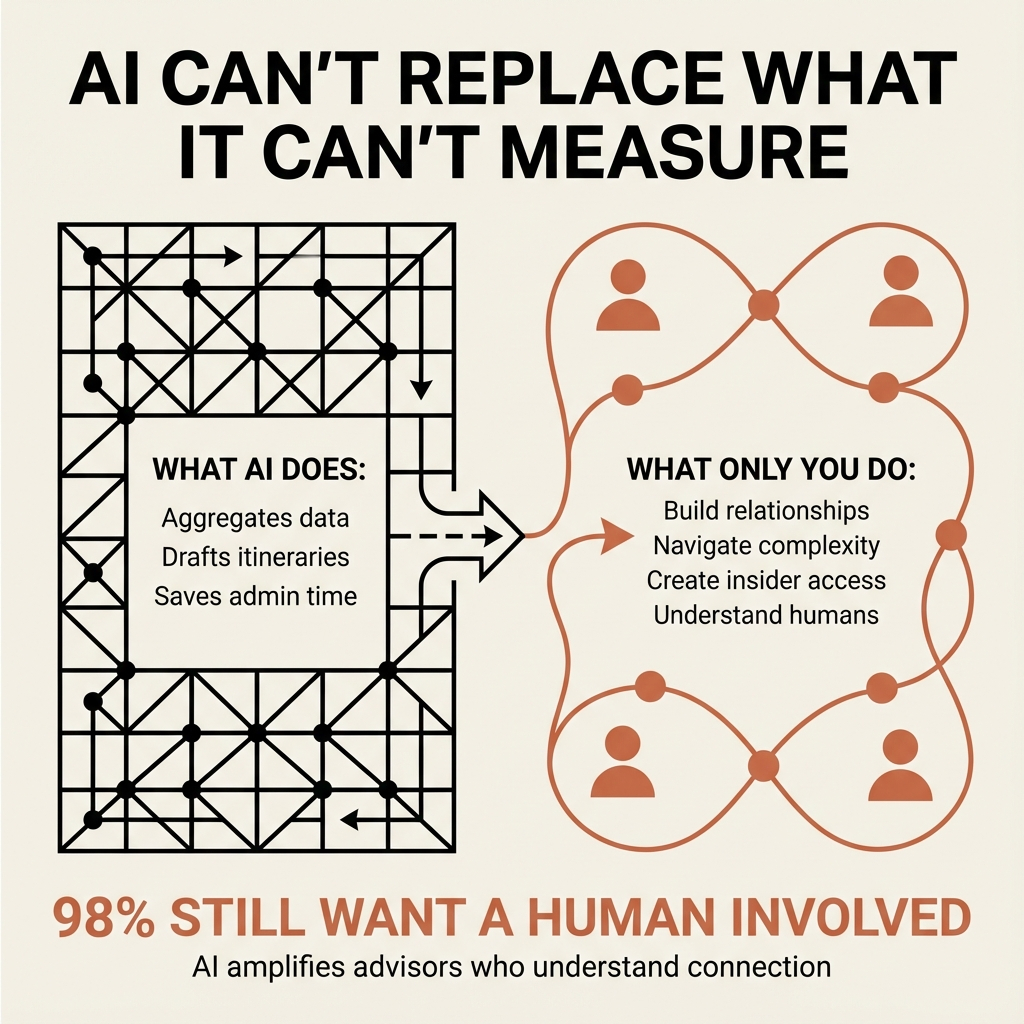
98% of people still want a human involved when real money and real trips are on the line.
Meanwhile, 59% of travel advisors now use AI platforms, up from 41% last year. And 79% predict revenue growth for their businesses.
The advisors adopting AI aren't scared. They're growing.
The pattern is clear: AI becomes a tool that makes good advisors better. It doesn't replace them.
What AI Cannot Do
I've spent my career building tech companies. I understand what technology can and cannot do.
AI cannot build relationships with hotel managers. It cannot navigate complex last-minute changes with empathy. It cannot organize those personalized upgrades that elevate a stay from good to unforgettable.
AI produces responses that are general and popular, not significant and relevant.
Only a human can take trip inspiration and turn it into something that fits your client's style, adds perks they can't book on their own, and makes sure their dream trip actually works in real life.
Upgrades. Early check-in. Late check-out. Complimentary breakfasts. Resort credits. Insider access.
Only a human travel advisor can negotiate these.
The Real Opportunity Hidden in This Shift
Here's what most advisors miss when they panic about AI:
Every hour AI saves you on admin work is an hour you can spend building relationships.
I work with advisors who use AI to draft itineraries, craft emails, and create social media content faster. They review and refine instead of creating from scratch.
That's a 10x workforce advantage.
One advisor I worked with updated his LinkedIn profile using AI tools. Within a week, an old client reached out to book again.
What changed? He showed up with intention, choice, and belief that what he was doing would work.
The advisors winning right now are the ones spending more time calling clients, following up after trips, getting to know people, reaching out at random times just to say hi.
They've shifted from transactional to relational.
Authority vs. Activity
There's a difference between posting about trips and being a thought leader.
An advisor who posts about trips is saying: "Look what I did."
A thought leader is saying: "Here's what I understand that you don't yet."
One shares experiences. The other teaches frameworks.
When you teach frameworks, clients get pre-sold on your judgment. Your content gets shared by peers. You attract clients who match your philosophy.
That's authority. And AI can't build that for you.
The Choice That Determines Everything
The UN declared 2026 the year of AI-Powered Tourism.
The real challenge isn't whether AI will disrupt travel. It already has.
The challenge is choosing to make AI part of your business in a way that supports you instead of replacing you.
Those who don't will get left behind. Not because AI is better at relationships, but because other advisors will use AI to free up time for the relationship work that actually matters.
There will always be a gap between hobbyists and business builders. Hobbyists can keep doing what they're doing. But if you want to grow a real business, you need to adopt the "with AI" approach.
AI works with you, not for you.
The moment you let AI just generate content without your voice, you create slop. Em-dashes everywhere. Triples of repeating words. Excessive emojis. Buzzwords that scream "generic AI wrote this."
People will know the difference. You might as well start a step ahead now.
What I Believe About Your Future
I've lived through the dot-com bubble. I've built tech businesses since 1998. I've seen industries transform.
Here's what I know: having a business is a personal growth journey with a compensation plan.
The more you grow, the more your compensation grows. The more you connect and build relationships, the more your business grows.
AI doesn't change that. It amplifies it.
Google's tools will get better. More AI travel assistants will launch. The technology will improve.
But the advisors who understand that their real value is human connection, judgment, and expertise? They'll thrive.
Because at the end of the day, people don't want a trip planned by data.
They want a trip planned by someone who cares.